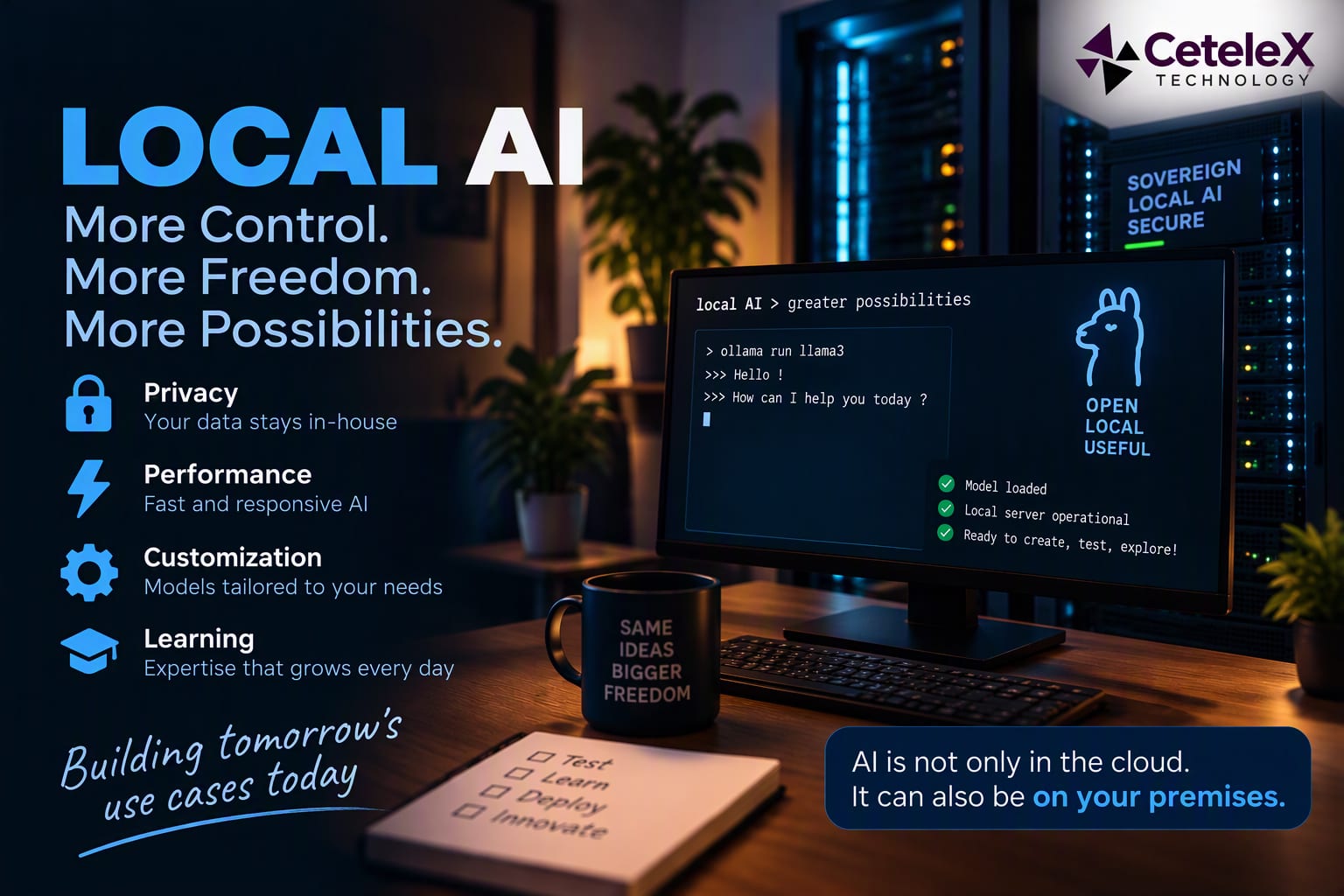
When people talk about artificial intelligence, they first think of online services where they send their questions and documents. Yet AI can also run in-house, on your own servers, without your data ever leaving the company. This is what we call sovereign AI, or local AI.
What is sovereign AI?
It is AI deployed directly on the infrastructure of the organisation that uses it: your servers, your network, your access rules. The language models (LLMs) that answer questions or read documents run locally. No data is sent to a third-party provider to be processed.
What it changes for your business
- Data privacy: contracts, invoices, customer files and financial data stay inside your environment.
- Locally hosted servers: you know where your models run and who can access them.
- Tailored models: the AI is adapted to your business, your vocabulary and your documents.
- Integration with what you already use: the AI plugs into your current tools, such as your ERP or document management.
- Control over costs and security: no usage-based bill that keeps climbing, and you set the protection rules.
What you can do with it in practice
- Intelligent assistants that answer in natural language based on your own data.
- Document analysis: automatic reading and extraction of information from invoices, contracts or purchase orders, including in Arabic.
- Automation of repetitive processes: sorting, data entry, checks, reconciliations.
- A copilot built into your Odoo ERP, to query your sales, stock or accounting without writing a query.
Cloud AI or local AI: how to choose?
Neither is better in every situation. Here are the criteria that matter.
- The cloud starts fast, with no hardware to buy, and gives access to the most powerful models of the moment. In return, your data is processed by a third party and the bill follows usage.
- Local AI keeps your data in-house and gives a more predictable cost. In return, it requires an upfront hardware investment, and open models can be somewhat less powerful than the best cloud models on the hardest tasks.
- For sensitive data (customers, finance, health, public bodies) or regulatory constraints on personal data protection, local AI is often the safest choice.
- A mixed approach is possible: local for sensitive data, cloud for the rest.
What hardware do you need?
It depends on the chosen model and the number of simultaneous users. Some light uses can run on a standard server. Heavier uses need a server with a graphics processor (GPU). Studying your use case makes it possible to size things right, without buying more than needed.
The steps of a local AI project
1. Choose a first use case
Start with a precise, high-return need: reading invoices, an internal assistant, support help. It is more effective than trying to do everything at once.
2. Review your data
What data will feed the AI, where is it, who can access it, in what format? The quality of the data determines the quality of the answers.
3. Choose and test the model
We compare several models on your own documents before deciding. Real results beat benchmark tables.
4. Install on your infrastructure
The model is deployed on your servers, with the access control, backup and monitoring you require.
5. Integrate with your tools
The AI connects to your ERP, document management or mailbox, so it serves where your teams already work.
6. Measure and improve
We track answer quality, correct, and extend to new uses step by step.
Frequently asked questions
Is local AI as capable as cloud AI?
For many business tasks (reading a document, answering from your data, classifying, summarising), yes. For the most complex reasoning tasks, the best cloud models may stay ahead. We check this on your case before committing.
Does my data leave the company?
No. The models run on your infrastructure and no data is sent to a third-party provider to be processed.
Is a GPU server mandatory?
Not always. Small uses can run without one. Heavier uses or many users need one. Sizing is done after studying the use case.
Can the AI be connected to Odoo?
Yes. An assistant can query your Odoo data in natural language, and automatic document reading can feed your invoices or purchases.
What now?
Sovereign AI is no longer a vision of the future: it is usable today, as long as you choose your first use case well. To see what we offer, visit our AI & Data offering. To talk to us, get in touch.